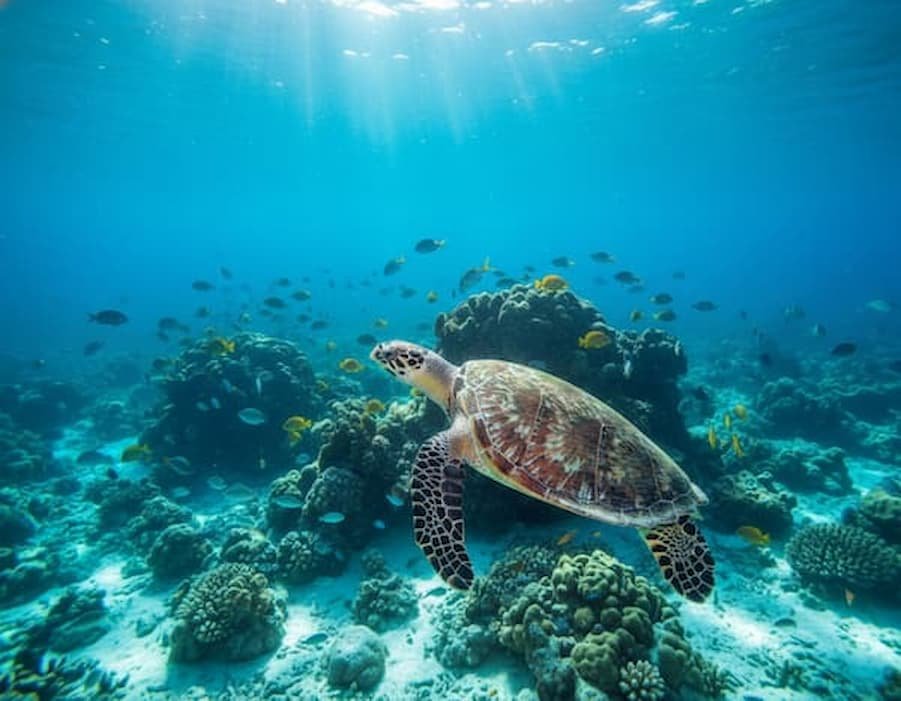
Carlisle Bay Marine Park serves as a critical sanctuary for Barbados’ marine biodiversity. The synergy between the Sunken Fleet—the park’s six historic shipwrecks—and the natural reef replenishment creates a unique underwater museum. Thanks to the bay’s natural geography, the waters remain calm and crystal clear, offering high-visibility conditions for spotting wildlife throughout the year. This marine park is not merely a tourist destination; it is a thriving artificial reef where man-made structures and natural organisms have reached a state of complex equilibrium.
I. The Living Sanctuary: Carlisle Bay’s Marine Biodiversity
The park functions as a dual ecosystem, bridging the gap between vast seagrass meadows and a concentrated artificial reef system. These two distinct habitats provide the necessary resources for a food chain that begins with microscopic plankton and extends to apex predators like the southern stingray. The transition from “sunken debris” to “thriving reefs” has occurred over a century, particularly on vessels like the Berwyn, which has been submerged since 1919. This century of growth has allowed soft corals and sponges to completely envelope the steel hulls, providing high-protein foraging grounds for resident species.
The artificial reefs created by the shipwrecks have turned a sandy bay into a thriving metropolis for Caribbean marine life.
Nutrient-rich currents flow steadily into the bay, supporting the caloric demands of the local sea turtle population. While many Caribbean sites suffer from coral depletion, the strategic placement of the shipwrecks in Carlisle Bay has mitigated habitat loss. The Ce-Trek, a concrete-hulled wreck scuttled in 1986, sits at a 12-metre depth and serves as a primary site for researchers studying how hard corals attach to man-made stone compared to traditional steel structures. It remains a fascinating focal point for those snorkelling in Barbados’ Carlisle Bay.
II. The Hawksbill Turtle: The Reef’s Essential Gardener
The hawksbill turtle (Eretmochelys imbricata) is categorised as a “spongivore,” a biological classification shared by very few vertebrates. Their specialised diet consists almost exclusively of sea sponges, which contain high concentrations of silica. This foraging behaviour is vital for the health of the Carlisle Bay Marine Park; without hawksbills to regulate their growth, aggressive sponges would overgrow the coral colonies and the shipwrecks themselves, eventually suffocating the delicate reef structure. By consuming these sponges, hawksbills maintain the spatial competition on the reef, allowing hard corals to thrive.
Identifying the Hawksbill
The hawksbill is distinguished by four prefrontal scales arranged in two distinct pairs between the eyes. Observe their shell; it features jagged, saw-like edges and overlapping scutes that create a serrated appearance. To see this without stressing the animal, always approach slowly from the side at a 45-degree angle rather than from directly above or behind.
Foraging Habits
Unlike the greens, hawksbills are frequently found navigating the nooks and crannies of the wrecks. They use their sharp, hawk-like beak to reach sponges wedged inside the rusted portholes of the Bajan Queen or the engine blocks of the Berwyn. They are the most agile of the bay’s turtles, often seen tucking their heads into small crevices to find food.
III. The Green Sea Turtle: The “Seagrass Mower” of the Bay
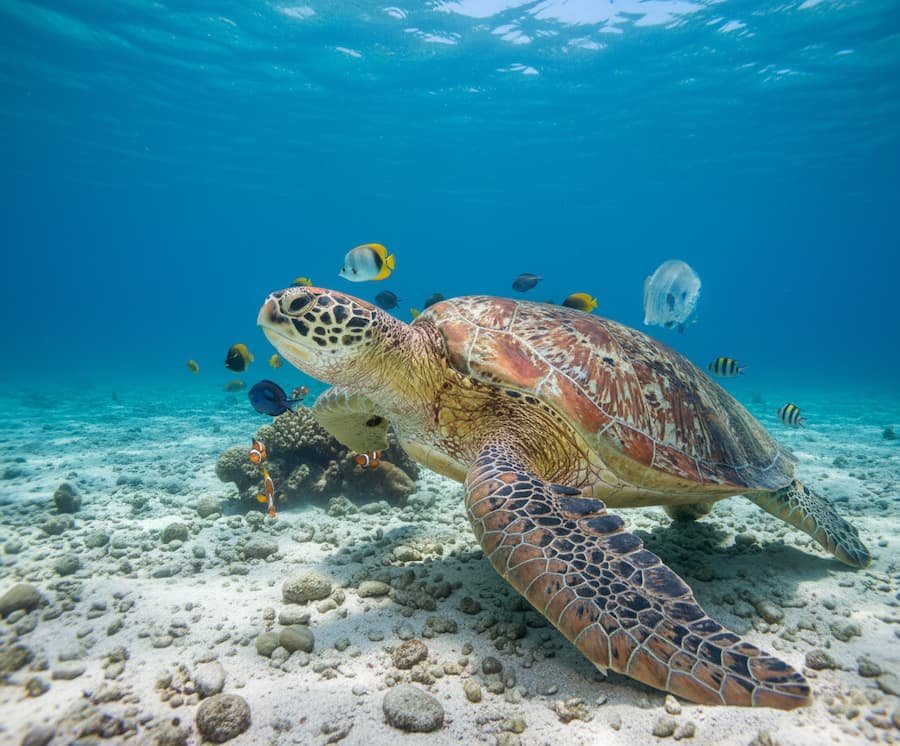
Green sea turtles (Chelonia mydas) are the primary residents of the bay’s vast seagrass beds. They act as natural “mowers,” grazing on the blades of seagrass to maintain a healthy and productive meadow. This grazing process is essential for nutrient recycling; it stimulates new, protein-rich growth that supports diverse fish populations. Without the consistent grazing of the green turtles, the seagrass would become overgrown, leading to an accumulation of detritus and a subsequent decrease in water quality and oxygen levels within the harbour.
| Feature | Green Sea Turtle | Hawksbill Turtle |
|---|---|---|
| Primary Diet | Seagrass & Algae | Sea Sponges |
| Shell Shape | Smooth, oval | Jagged, ‘saw-like’ edges |
| Presence | Year-round ‘Residents’ | Year-round ‘Residents’ |
| Beak | Short, blunt | Sharp, hawk-like hook |
| Scales | Two prefrontal scales | Four prefrontal scales |
Green turtles are generally more docile than hawksbills and spend a significant portion of their day resting on the sandy floor or grazing in the shallow meadows. Identification is straightforward: they possess exactly two elongated prefrontal scales between their eyes and have a shell that is smooth and oval-shaped. While they are year-round residents, they are often seen surfacing for air more frequently in the early morning hours when boat traffic from the Bridgetown Port is at its lowest.
IV. Beyond the Shell: Shipwreck Specialists and Camouflage
The wildlife in Carlisle Bay extends far beyond the turtles. Caribbean reef squid are frequently spotted in disciplined schools, though they rarely hover directly over the wrecks. Instead, they position themselves just beneath the mooring and buoy lines, using the vertical structures as reference points in the open water. On the rusted railings of the Bajan Queen, visitors who adopt a “slow-look” snorkeling approach may discover seahorses. These masters of disguise camouflage themselves against the oxidised iron and encrusting sponges, remaining perfectly still to avoid detection by predators.
The Barge, sitting at a shallow 3.6 metres, is the preferred territory of the porcupinefish, while the Ce-Trek often hosts the longlure frogfish. These frogfish resemble nondescript clumps of yellow or orange sponge. Near the sandy periphery of the shipwrecks, southern stingrays frequent “cleaning stations.” At these specific locations, small bluehead wrasse or Spanish hogfish perform a symbiotic service, picking parasites and mucus off the stingrays’ wings. It is worth noting that female southern stingrays are significantly larger than males, reaching widths of up to six feet—more than twice the size of their male counterparts.
V. The Barbados Sea Turtle Project (BSTP) & Conservation
The survival of these species depends on the rigorous conservation efforts of the Barbados Sea Turtle Project (BSTP). Data from the BSTP indicates that only 1 in every 1,000 hatchlings reaches reproductive maturity, which typically occurs between 25 and 30 years of age. This statistic highlights why the protected status of Carlisle Bay is so critical; it provides a safe haven during the most vulnerable years of a turtle’s life cycle. The project maintains a 24-hour wildlife hotline (+1 246-230-0142) for visitors to report nesting events or hatchlings that have become disoriented by coastal lighting.
Always use reef-safe sunscreen. Traditional chemicals like oxybenzone can bleach the corals that these turtles rely on for survival.
Many nearby facilities have adapted their infrastructure to support these conservation goals. Local hotels and beach clubs have transitioned to red-wavelength lighting on their beachfronts. Because sea turtles are less sensitive to red light, this helps prevent hatchlings from mistaking hotel lights for the moon reflecting on the ocean, which would otherwise lead them inland to their death rather than out to sea. Visitors are encouraged to report any injured turtles or disoriented hatchlings directly to the hotline rather than attempting an intervention themselves.
Top Wildlife & Snorkel Tours
Marine Park Sanctuary Boundaries
Frequently Asked Questions
- When is the best time to see turtles in Carlisle Bay? While turtles are present throughout the year, the optimal viewing window is between 8:00 AM and 10:00 AM. During this period, the water is generally at its calmest and the large catamaran tours have not yet arrived, allowing for a more intimate and less crowded experience.
- Is it legal to touch the turtles? No, it is strictly prohibited by Barbadian law to touch, chase, or attempt to ride the sea turtles in the marine park. Such actions cause the animals significant physiological stress and can disrupt their natural foraging and breathing cycles.
- Do I need a boat to see them? While some green turtles frequent the shallow seagrass beds near the shore, the highest concentration of both species is found near the shipwrecks. These sites are less than 200 metres offshore and are best reached via a licensed snorkel boat or by strong swimmers equipped with proper safety markers.
- What should I do if I see a turtle in distress? You should immediately call the Barbados Sea Turtle Project 24-hour hotline at +1 246-230-0142 to report the animal’s location and condition. Do not attempt to handle the turtle yourself, as you may inadvertently cause further injury or stress to the animal.
- Are there jellyfish in the bay? Jellyfish are occasionally present, though the bay’s naturally sheltered geography generally keeps them at a distance from the main snorkeling areas. If you are concerned about stings, wearing a thin rash guard or “sun shirt” provides an effective physical barrier for your skin.
For more information on planning your trip, visit our guide on Visitor Services or explore the best dining options along the shore after your snorkel session.